Tankers!!
A Tank Recovery Vehicle (TRV) is an armoured vehicle used during combat for recovery or repair of battle-damaged and inoperable armoured fighting vehicles. The terms "Armoured Recovery Vehicle" (ARV) and "Armoured Repair and Recovery Vehicle" (ARRV) are also used.
 |
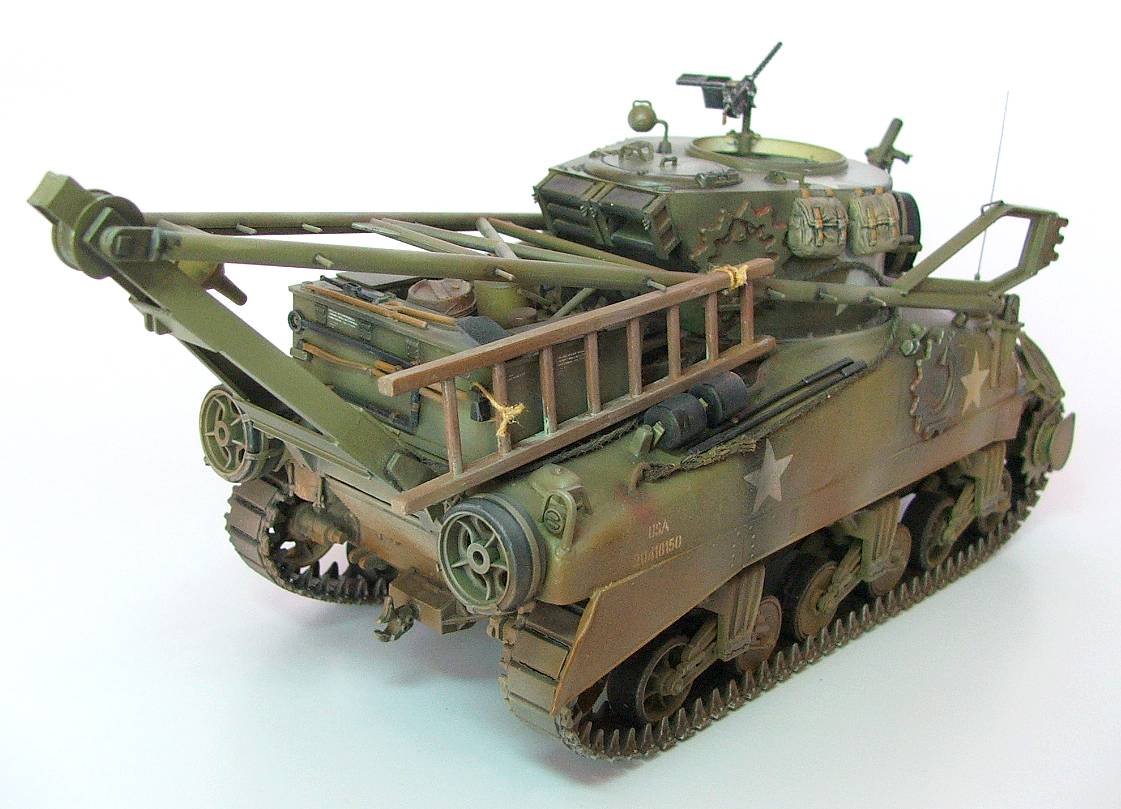
| M32B1 TRV - 3/4 front view |
History of Recovery Vehicles:
- WWI - Early models
During the World War I, some
British Mark IV heavy tanks were fitted with jibs to produce "Salvage Tanks", but the majority of their work was at the tank parks in aid of maintaining and repairing damaged tanks.
 |
| British Mk IV tank with crane... |
- WWII
The first true ARVs were introduced in World War II, often by converting obsolete or damaged tanks, usually by removing the turret and installing a heavy-duty winch to free stuck vehicles, plus a variety of vehicle repair tools. Some were also purpose-built in factories, using an existing tank chassis with a hull superstructure to accommodate repair and recovery equipment. Many of the latter type of ARV had an
A-frame or
crane to allow the vehicle's crew to perform heavy lifting tasks, such as removing the engine from a disabled tank.
 |
| An American exemple of TRV: M31 TRV |
 |
| A German exemple: Bergepanther |
 |
| A british example: Cromwell ARV towing a Pz IV |
- Postwar
After World War II, most countries' MBT models also had corresponding ARV variants. Many ARVs are also equipped with a bulldozer blade that can be used as an anchor when winching or as a stabiliser when lifting, a pump to transfer fuel to another vehicle, and more. Some can even carry a spare engine for field replacement, such as the
German Leopard 1 ARV.
M32 TRV:
The M32 Tank Recovery Vehicle, or M32 TRV, was a variant of the M4 Sherman Medium Tank chassis with the normal turret replaced by a fixed turret, in a different format on the top of the hull and the installation of an 5,5 m A-frame crane and 27 ton. winch. The M32 Tank Recovery Vehicle slowly replaced the
M31 Tank Recovery Vehicle, starting in 1944.
The A-frame crane was mounted to the front of the hull, but folded in a tilted-back position for travel or for towing.
 |
| M32 with A frame in tilted-back position |
The winch on the M32 Tank Recovery Vehicle could be attached to a load in the front or rear, over the crane or through an aperture on the front armor.
 |
M32 front armour - notice the aperture, the armoured flap and
the absence of of the steel cable rollers and its frame. |
 |
| The M32 front with flap closed and the frame for steel cable. |
About 1562 units were built, the total of all variants and a number of manufacturers. U.S. Allies, including the British and French received some of the M32 Tank Recovery Vehicles.
M32 types;
As the M4 Sherman evolved, the changes were passed on to the M32 TRV. The M32 and M32B-series were earlier models with VVSS suspensions. The M32A1-series are later models with a HVSS suspensions. The armament of the M32 TRV consisted of a .50 cal. M2 machine gun on a turret ring mount, plus an M1919A4 .30 cal. machine gun in a ball mount in the right front of the hull. An 81mm mortar was mounted on the hull front, just ahead of the turret, to lay down obscuring smoke. The mortar was eliminated in later production.
 |
| M32B1 - 3/4 rear view |
 |
| M32B1 with crane in position |
Specs:
| M32B1 Tank Recovery Vehicle |
|---|
| Type | Recovery tank |
|---|
| Place of origin | United States |
|---|
| Service history |
|---|
| Wars | World War II |
|---|
| Production history |
|---|
| Production | Jun 1943 - Jun 1945 |
|---|
| Number built | 1055 |
|---|
| Variants | see text |
|---|
| Specifications |
|---|
| Weight | 28 t |
|---|
| Length | 5.92 m (without sandshields) |
|---|
| Width | 2.68 m (without sandshields)
2.10 (tread) |
|---|
| Height | 2.73 m with crane lowered
6.40 m crane top, lifting posit. |
|---|
| Crew | 4 |
|---|
|
| Armor | front: 61 mm Steel |
|---|
Main
armament
| M1 mortar 81mm |
|---|
Secondary
armament
| 1 x MG .50 cal 1 x MG .30 cal |
|---|
| Engine | M-31:Wright (Continental) R975 EC2
400 hp - gasoline |
|---|
| Transmission | Synchromesh, 5 speeds forward, 1 reverse |
|---|
| Suspension | vertical volute spring |
|---|
| Fuel capacity | 662 liters gasoline |
|---|
Operational
range
| 190 km gasoline |
|---|
| Speed | 40 km/h (road)
22 km/h (off-road) |
|---|
Steering
system
| Controlled differential |
|---|
The kits:
To build this project, I used the Italeri kit:
 |
| M32 Italeri kit. |
Odd the Italeri have chosen the big-hatch version to represent a vehicle WWII. Much has been discussed about the existence or not of this version in WWII. Here some pictures that our friend Emanuel Morales "Zeke" sent us about the presence of M32B1 big-hatch operating in Europe. Thanks, Zeke !!
 |
M32B1 big-hatch: a true oddball!!
Zeke pic |
But I'll do my model representing the most common version (small-hatch). For this, I change the Italeri's big-hatch upper hull for an old resin M4A1 hull small-hatch. The Italeri kit also lacks a well-detailed interior...